
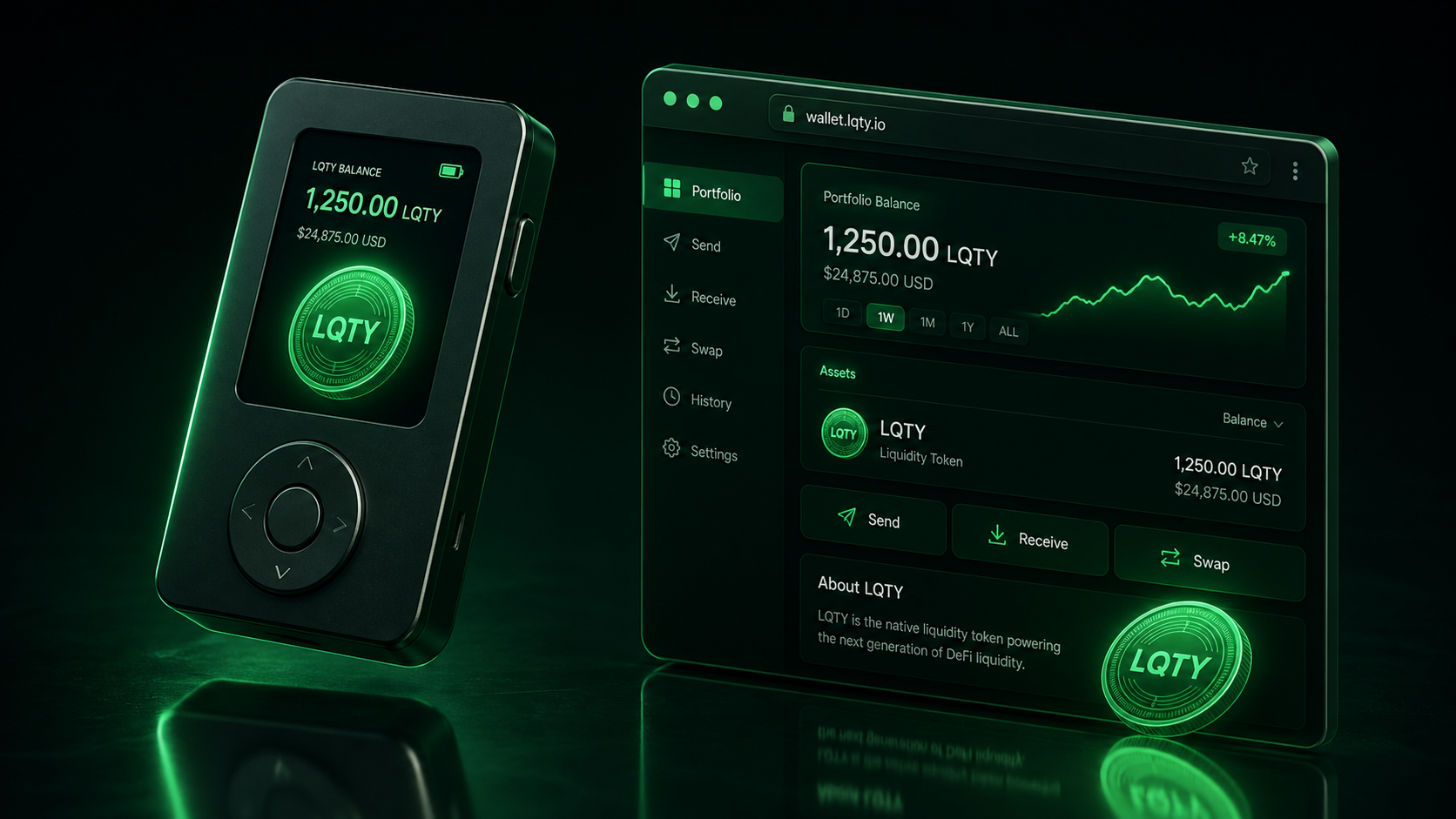
Any Ethereum wallet that supports ERC-20 tokens can hold LQTY, so the real question is what you plan to do with it. Passive holders are best served by a hardware wallet. Anyone who wants to stake and vote on Liquity incentives needs a wallet that connects cleanly to independent web frontends, because the protocol operates none of its own. Those two use cases point at different tools.
LQTY is a standard token with no rebasing, no wrapping, and no chain-specific quirks, which keeps the compatibility question simple and shifts the decision entirely onto custody and workflow.
What LQTY Storage Actually Requires
LQTY lives at 0x6dea81c8171d0ba574754ef6f8b412f2ed88c54d on Ethereum mainnet, with a bridged deployment on Arbitrum One. Most wallets will not display it automatically, so you may need to add it as a custom token using that contract address, which is published on Etherscan and on the token's CoinGecko listing.
Two details matter beyond basic compatibility. First, LQTY has a hard cap and no emissions, so a balance sitting in cold storage never dilutes and never needs to be claimed or compounded, which the token's fixed supply and fee structure make explicit. Second, staking rewards from Liquity V1 accrue to the staking contract rather than to the wallet balance, so a hardware wallet holding unstaked LQTY earns nothing at all. That distinction between the two protocols is worth understanding before choosing storage, since Liquity V1 and V2 pay stakers differently.
Hardware Wallets for Long-Term Holding
Ledger
Ledger devices support LQTY through the Ethereum app and pair with browser wallets for anything on-chain. The private key never leaves the device, and every transaction requires physical confirmation, which is the meaningful protection against a compromised browser. Ledger also connects to Liquity's community frontends through a software wallet acting as the bridge, so staking from cold storage is possible without exposing the key.
Trezor
Trezor offers the same core protection with fully open-source firmware, which some holders prefer on principle. LQTY appears as a custom ERC-20 token once the contract address is added. Trezor's browser integration is slightly less polished for DeFi frontends than Ledger's, so holders who intend to vote weekly may find the workflow slower.
For pure buy-and-hold positions, either device is appropriate, and the general case for cold wallet storage applies to LQTY the same way it applies to any long-term holding.
Software Wallets for Staking and Voting
Staking LQTY means connecting to one of the independent frontends Liquity lists, such as Liquity.App, DeFi Saver, LQTY.IO or Trove Zero, since Liquity AG runs no interface of its own. That makes browser wallet quality a practical concern rather than a preference.
MetaMask remains the default for a reason: every Liquity frontend supports it, custom tokens are simple to add, and hardware wallets connect through it. Its transaction previews are weaker than newer alternatives, which matters when approving contracts.
Rabby improves on that specifically. It simulates transactions before signing and shows exactly which balances will change, which is useful when interacting with a staking proxy contract that many wallets flag as unrecognised on first use. Liquity deploys one of those per staking address, and a wallet that explains the interaction rather than warning about it reduces the chance of an unnecessary rejection.
Safe suits treasuries and shared positions. Multi-signature approval fits the staking pattern well, because voting power accrues with time and a Safe discourages the impulsive unstaking that resets it. Anyone running the full LQTY staking and voting workflow from a shared wallet should expect an extra approval step per epoch.
Software wallets carry the risks that come with living in a browser, and the tradeoffs described in hot wallet storage apply here in full.
Self-Custody Versus Leaving LQTY on an Exchange
Holding LQTY on an exchange is reasonable if you are trading it. It becomes a constraint the moment you want to do anything the protocol offers, because staking, voting, and any activity that accrues fork rewards all happen on-chain and require keys you control.
That last point is easy to underestimate. The licensed fork ecosystem distributes token allocations based on on-chain BOLD activity, and an exchange balance participates in none of it. Holders who want the full return profile from the Liquity ecosystem, including BOLD's native yield, need a self-custody wallet. Understanding how wallets and private keys work is the prerequisite for all of it.
Frequently Asked Questions
Can you store LQTY in MetaMask?
Yes. LQTY is a standard ERC-20 token on Ethereum, so MetaMask holds it once the contract address is added as a custom token. MetaMask also connects to every Liquity frontend, which makes it the simplest option for staking and weekly voting. Pairing it with a hardware wallet keeps the private key offline while retaining that access.
Do you need a special wallet to stake LQTY?
No special wallet is required. Any Ethereum wallet that can connect to a web frontend and sign transactions will work. The first time an address stakes, Liquity deploys a small proxy contract to hold the position, and some wallets display a new-contract warning at that point. That behaviour is expected.
Is LQTY available on networks other than Ethereum?
LQTY's primary deployment is on Ethereum mainnet, with a bridged version on Arbitrum One. The staking and voting contracts live on Ethereum, so participating in Liquity governance requires holding the mainnet token. Check the contract address carefully before sending, since bridged and native versions are separate assets.
Matching the Wallet to How You Use LQTY
The right LQTY wallet follows from intent rather than from any feature comparison. A holder who intends to stake and vote for years should optimise for a workflow they will use weekly, which means a browser wallet with good transaction previews, ideally backed by a hardware device. A holder who wants exposure and nothing else should put the tokens on a hardware wallet and leave them there.
The one storage decision with a real cost is defaulting to an exchange balance out of habit. That forfeits staking revenue, voting power that compounds with time, and any fork rewards, all of which sit alongside the directional exposure covered in LQTY's price outlook.
For the trading side of the position, LeveX lists LQTY spot pairs and LQTY perpetual contracts. Wallet and custody guides for other assets are collected in Crypto in a Minute.