
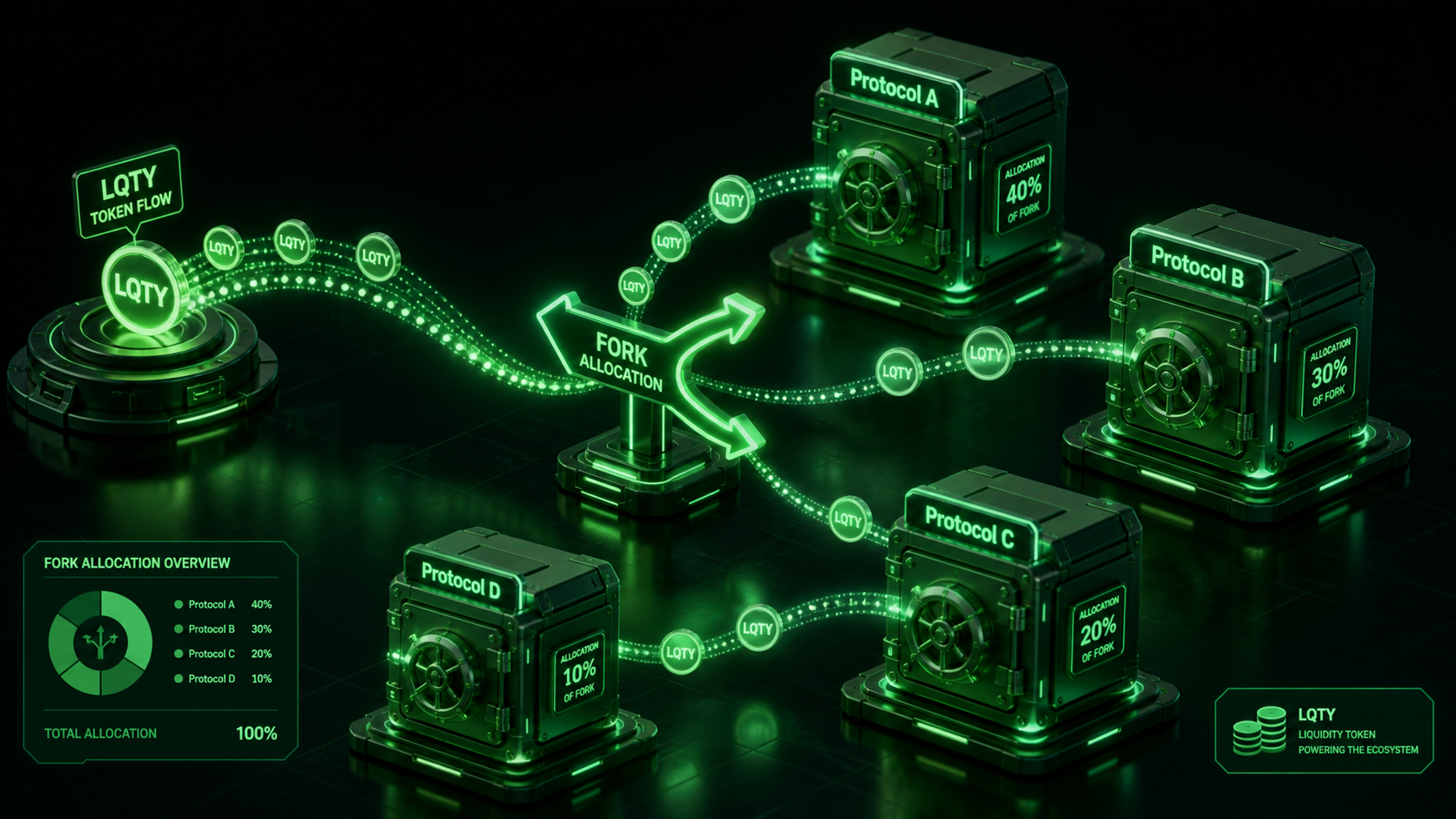
More than twenty teams have licensed the Liquity V2 codebase to launch their own stablecoin, and every one of them has agreed to hand roughly 4% of its token supply to people who use BOLD. Eleven of those deployments were live as of August 2026, spread across Hyperliquid, Scroll, Arbitrum, Avalanche, Flare, Sonic and others. Liquity's own estimate puts the combined airdrop value between $20 million and $70 million.
The industry usually treats forks as theft. Liquity turned them into a distribution channel, and the arrangement now supports more total value on other chains than the original protocol holds on Ethereum.
What a Friendly Fork Actually Is
Liquity V1 was released under a permissive open-source licence, and dozens of teams copied it without giving anything back. V2 shipped differently. The codebase carries a business licence, which means a team that wants to deploy it has to sign an agreement first, and the standard terms of that agreement include a reward commitment to BOLD users.
A fork takes the Liquity V2 architecture more or less intact: Troves, user-set interest rates, branch-level Stability Pools, and redemptions ordered from the lowest rate upward. What changes is the collateral set and the chain. Felix issues a dollar backed by Hyperliquid-native assets, Ēnosys built the first XRP-backed stablecoin on Flare, and Nerite runs on Arbitrum with its own collateral mix. The mechanism design that separates Liquity V2 from V1 is exactly the part being replicated.
The Forks Running Today
Eleven deployments were live as of August 2026, according to Liquity's fork directory:
- Felix on Hyperliquid, the largest of the fork deployments by activity
- Quill on Scroll and Orki on Swellchain, both L2-native dollars
- Nerite on Arbitrum
- Ebisu, Asymmetry and DeFi Dollar on Ethereum, with Ebisu also live on Plasma
- Aesyx on Avalanche
- Soneta on Sonic and Mustang on Saga EVM
- Ēnosys on Flare, issuing a stablecoin backed by XRP
Beraborrow on Berachain and Alpen on Bitcoin were queued behind them, with further deployments planned for Linea, Unichain, Polygon, Sei, Gnosis, MegaETH, Ethena and Katana. Each carries its own risk profile, since a fork inherits Liquity's code but not Liquity's collateral quality or oracle setup.
How the Reward Program Works
The commitment breaks into two parts. Roughly 2.75% of each fork's token supply goes to BOLD users across DeFi, meaning holders who deploy BOLD into qualifying venues rather than leaving it idle. The remaining 1.25% or so goes to liquidity providers in pools pairing BOLD against the fork's own stablecoin.
Eligibility is tracked through points, and Liquity maintains public leaderboards showing where each address ranks. Because the reward is denominated in a percentage of supply rather than a dollar figure, the value depends entirely on where the fork tokens eventually trade, which is why the program's own estimate spans a range as wide as $20 million to $70 million.
For a stablecoin the size of BOLD, that is a substantial incentive stacked on top of the native yield. Holding BOLD and depositing it productively earns interest revenue from Liquity borrowers plus airdrop exposure to a dozen ecosystems at once, which explains why BOLD circulation has held up better than the protocol's modest fee revenue would suggest.
What the Strategy Costs Liquity
None of the fee revenue generated by a fork returns to Liquity or to LQTY stakers. Felix's borrowers pay interest to Felix depositors, Nerite's pay Nerite's, and the licence brings back token allocations for BOLD users rather than a cut of anything recurring. Liquity built the standard and handed the economics away.
The bet behind that decision is that BOLD becomes the asset the fork ecosystem routes through, which would grow the debt book that LQTY stakers actually earn from. So far the evidence is mixed. Liquity V2's TVL sat around $72 million in August 2026 against annualized fees near $2 million, numbers that do not reflect twenty deployments' worth of design influence. The weekly incentive budget that LQTY stakers vote to allocate scales with that book and nothing else.
There is a defensible reading of the strategy. A CDP design that runs on a dozen chains becomes the reference implementation, and reference implementations attract integrations, auditors, and borrowers who trust code they have seen before. That is a slow compounding advantage rather than a revenue line, and LQTY's fixed supply and fee structure give holders no way to capture it except through eventual borrowing demand.
Frequently Asked Questions
How do you qualify for Liquity fork airdrops?
Qualification comes from holding and deploying BOLD in venues the program recognises, or from providing liquidity to pools pairing BOLD with a fork's stablecoin. Activity is tracked as points and published on public leaderboards. The reward percentages are set by each fork's licence agreement, so the eventual value depends on how those tokens price at launch.
Are Liquity forks safe to use?
A fork inherits Liquity V2's audited architecture but not its safety record. Each deployment chooses its own collateral assets, oracles, and chain, and any of those can fail independently of the code. Forks that launched before the February 2025 Stability Pool fix also had to patch their own deployments. Treat each one as a separate protocol carrying separate risk.
Why does Liquity allow forks at all?
Liquity V2 uses a business licence that turns forking into a negotiated arrangement rather than an uncompensated copy. Teams get audited CDP code and a live user base, and Liquity gets a reward stream for BOLD holders plus wide adoption of its design. The friendly fork program formalises those terms.
Building a Standard Instead of a Moat
Liquity's fork program is one of the more interesting distribution experiments in DeFi. Rather than defending the code, the team priced it, and the price it charged was an airdrop to its own stablecoin holders. That turned a small Ethereum protocol into the borrowing engine for a dozen chains within about a year.
The unresolved question is whether design leadership eventually converts into fee revenue, because that conversion is what supports LQTY's price outlook. Twenty forks make BOLD relevant. Only borrowing volume makes LQTY valuable.
You can trade LQTY on the spot market or take a leveraged position through LQTY perpetual futures on LeveX. More protocol deep dives are collected in Crypto in a Minute.