
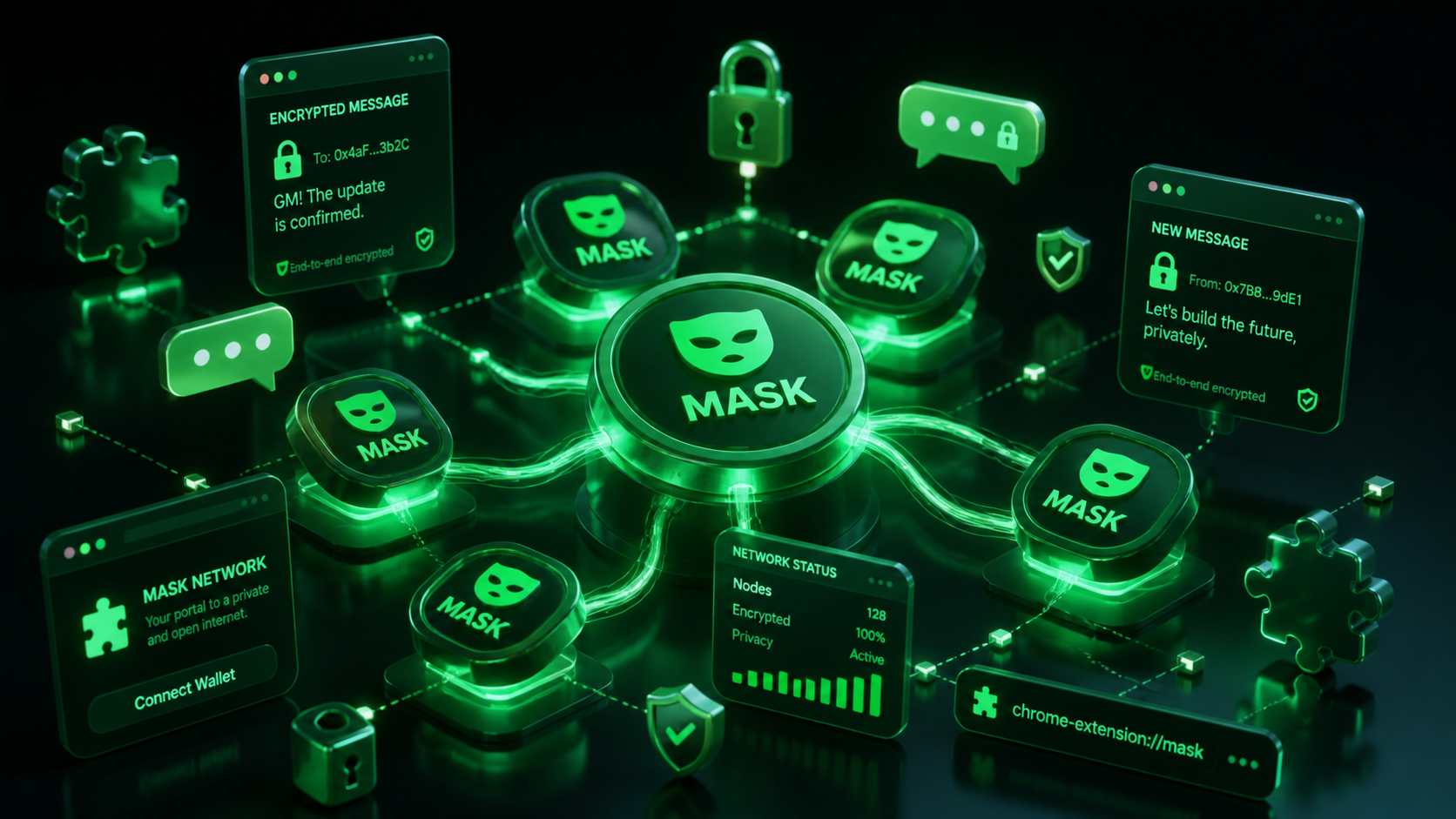
Mask Network is a browser extension that adds Web3 functions to the social platforms people already use, letting them publish encrypted posts, send tokens, and display on-chain profiles inside X, Facebook, and Instagram. MASK is the ERC-20 governance token of MaskDAO, the organization that owns the ecosystem, capped at 100 million units and fully circulating since early 2024.
The project spent five years as a plugin. In January 2026 it took on something considerably larger: stewardship of Lens, the decentralized social graph that Aave developer Avara had built and funded since 2022. That handover reframed MASK from a browser-extension token into the governance asset of the group now steering one of the largest open social protocols in crypto.
Turning a Social Feed Into a Web3 Interface
The extension works by treating a social platform as a dumb transport layer. Nothing about X changes, and X never learns what was said.
- Install the extension on Chrome, Firefox, Brave, or Opera, and it generates an encryption keypair locally on the device.
- Compose a post inside the extension's overlay rather than the platform's own box.
- The extension encrypts the text and publishes the resulting ciphertext as an ordinary-looking post.
- Anyone holding the extension and a valid key sees plaintext. Everyone else, including the platform, sees a string of characters.
Around that encryption core sits a plugin system that reaches further than messaging. Lucky Drop lets a user attach tokens or NFTs to a post as a claimable giveaway, which became the project's most viral feature. Other plugins render NFT collections in profile headers, execute token swaps without leaving the timeline, aggregate wallet activity into a single social identity, and host token sales through the Initial Twitter Offering format the team invented for its own launch. The extension stores no personal data on a server and the code is public on GitHub, which is how a tool that intermediates social logins earned enough trust to keep users for six years.
From Maskbook to Lens Steward
Mask Network began in 2019 as Maskbook, a side project from Dimension, the software studio founded by Suji Yan. The pitch then was narrow: encrypt a Facebook post so that Facebook could not read it.
February 2021 turned it into a token. Mask ran the first Initial Twitter Offering using its own plugin, distributing 3% of supply through fixed-price rounds capped at 2,000 MASK per address and a further 4% through a Balancer bootstrapping pool, with an airdrop reserved for early users. MASK peaked at $41.45 on 24 February 2021, days after launch, a level it has never revisited.
Four years later the structure changed again. In February 2025, MaskDAO announced it would spin off its three strongest products into independently operated projects, each free to build its own team and its own tokenomics. Then came 2026. In February the group standardized encrypted messaging across its apps by adopting XMTP, so a conversation started in one client continues in another with history intact. And on 20 January 2026, Lens announced Mask Network as its new steward, with Avara stepping back to technical advisory. Aave founder Stani Kulechov framed it as a refocus on DeFi rather than a retreat from social.
The Products Sitting Under MaskDAO
The 2025 reorganization left MaskDAO as a holding structure with several consumer-facing brands beneath it.
Firefly
Firefly is the group's flagship app, a mobile and web client that merges X, Lens, and Farcaster feeds into one timeline and layers in Mirror articles, Snapshot votes, Polymarket markets, and NFT activity. It keeps full X functionality while writing to decentralized networks in parallel, which is why Vitalik Buterin has publicly praised its interface. Firefly is where most new users now meet the ecosystem, since a mobile app reaches an audience a desktop browser extension never could.
Next.ID
Next.ID is the identity layer, a protocol that binds together the wallets, social handles, and domains belonging to one person into a verifiable graph. It answers a question that gets harder as social moves on-chain: proving that a given X account and a given Ethereum address belong to the same human.
Web3.bio
Web3.bio is the public read layer on top of that identity data, a profile service that resolves ENS names, Lens handles, Farcaster IDs, and wallet addresses into a single page. Developers use its API as identity infrastructure, which quietly makes it one of the most integrated pieces of the stack.
Alongside these sits Orb, the Lens-native mobile client that came with the stewardship mandate, giving the group two consumer apps pointed at overlapping audiences.
What the MASK Token Actually Does
MASK is a governance token first. Each unit carries one vote in MaskDAO, and votes require the tokens to have been locked in governance for seven days before a proposal opens, a rule designed to stop anyone borrowing voting power for a single decision. Beyond voting, MASK gates access to certain advanced extension features such as cross-chain wallet functions and enhanced profiles, and the DAO has periodically run staking and reward seasons that pay MASK to active users.
Here is where the token stands as of August 2026, per CoinGecko:
| Metric | Value |
|---|---|
| Price | ~$0.36 |
| Market cap | ~$35.5 million (rank #564) |
| Circulating supply | 100,000,000 of 100,000,000 |
| Market cap / FDV | 1.0 |
| 24h volume | ~$5.3 million |
| All-time high | $41.45 (24 Feb 2021) |
| All-time low | $0.3312 (6 Jun 2026) |
The contract lives on Ethereum at 0x69af...3074, with bridged versions on BNB Smart Chain, Polygon, and Energi. Mask Network runs no chain of its own, and it never has.
Risks and Open Questions for MASK Holders
Four things deserve attention before taking a position.
The ticker is contested. MetaMask has confirmed a native token that the market already calls $MASK, with a launch window widely expected in late 2026. That creates real confusion risk on symbol-based searches, and it has already produced a wave of phishing sites impersonating the claim page. LeveX has covered how to position for the MetaMask airdrop separately, and the two assets have nothing to do with each other.
Value accrual is indirect. MASK governs a portfolio of products that were deliberately given permission to raise money and design tokenomics of their own. Firefly succeeding does not automatically mean MASK capturing that success, and holders are exposed to a governance claim rather than a revenue stream.
The chart is unforgiving. MASK sits roughly 99% below its 2021 peak and about 7% above an all-time low set in June 2026. Price has fallen around 73% over the trailing year, which tells you the market has been discounting the Lens news rather than celebrating it.
Adoption is the fourth variable and the hardest to forecast. Decentralized social has produced strong infrastructure and thin usage for years, and Mask's entire thesis rests on turning that infrastructure into products with ordinary users. The stewardship deal explicitly transferred no treasury, no intellectual property, and no governance control, so what Mask received was a mandate to ship rather than an asset to monetize.
Frequently Asked Questions
What is Mask Network used for?
Mask Network is used to add Web3 capability to mainstream social platforms without leaving them. The most common uses are sending encrypted posts and direct messages that the platform cannot read, attaching token or NFT giveaways to posts through Lucky Drop, showing verified on-chain identity and NFT holdings on a profile, and swapping tokens inside a feed.
Does Mask Network have its own blockchain?
No. MASK is an ERC-20 token on Ethereum, with bridged deployments on BNB Smart Chain, Polygon, and Energi. Mask Network is application software, so it inherits security and settlement from the chains it connects to.
Is MASK the same as the MetaMask token?
They are separate assets that share a ticker. Mask Network's MASK launched in February 2021 with a fixed 100 million supply and trades today around a $35 million market cap. MetaMask's token has not launched as of August 2026 and would arrive with entirely different supply mechanics and ownership.
How many MASK tokens are there?
The supply is fixed at 100 million MASK, created at genesis in 2021 with no minting function. All of it circulates, so market cap and fully diluted valuation are identical and no unlock schedule hangs over the price.
Is Mask Network free to use?
The browser extension and its core features are free and open source. Some advanced functions require holding MASK, and on-chain actions taken through the extension, such as swaps or giveaways, cost the usual network gas fees.
Where Mask Network Fits in Web3 Social
Mask Network occupies an unusual position: a small-cap token governing a product suite with genuine distribution. Firefly has users, Web3.bio quietly powers identity lookups across dozens of applications, and the Lens mandate hands the group the largest open social graph in crypto to develop. Very few $35 million tokens sit on top of that much surface area, which is either a mispricing or an accurate read of how little of that surface flows back to holders.
The next twelve months should settle it. If consumer apps built on Lens produce retention that earlier decentralized social attempts never found, MaskDAO governs the layer where that happens. If they do not, MASK remains a governance claim on a well-engineered stack that nobody outside crypto uses. Traders taking either view should size the position for a token that trades $5 million a day and sits near multi-year lows.
Trade MASK on the spot market or open a leveraged position with MASK perpetual futures on LeveX, and read our support explainer on spot and futures trading first if you are new to the difference. More token breakdowns live in Crypto in a Minute.