
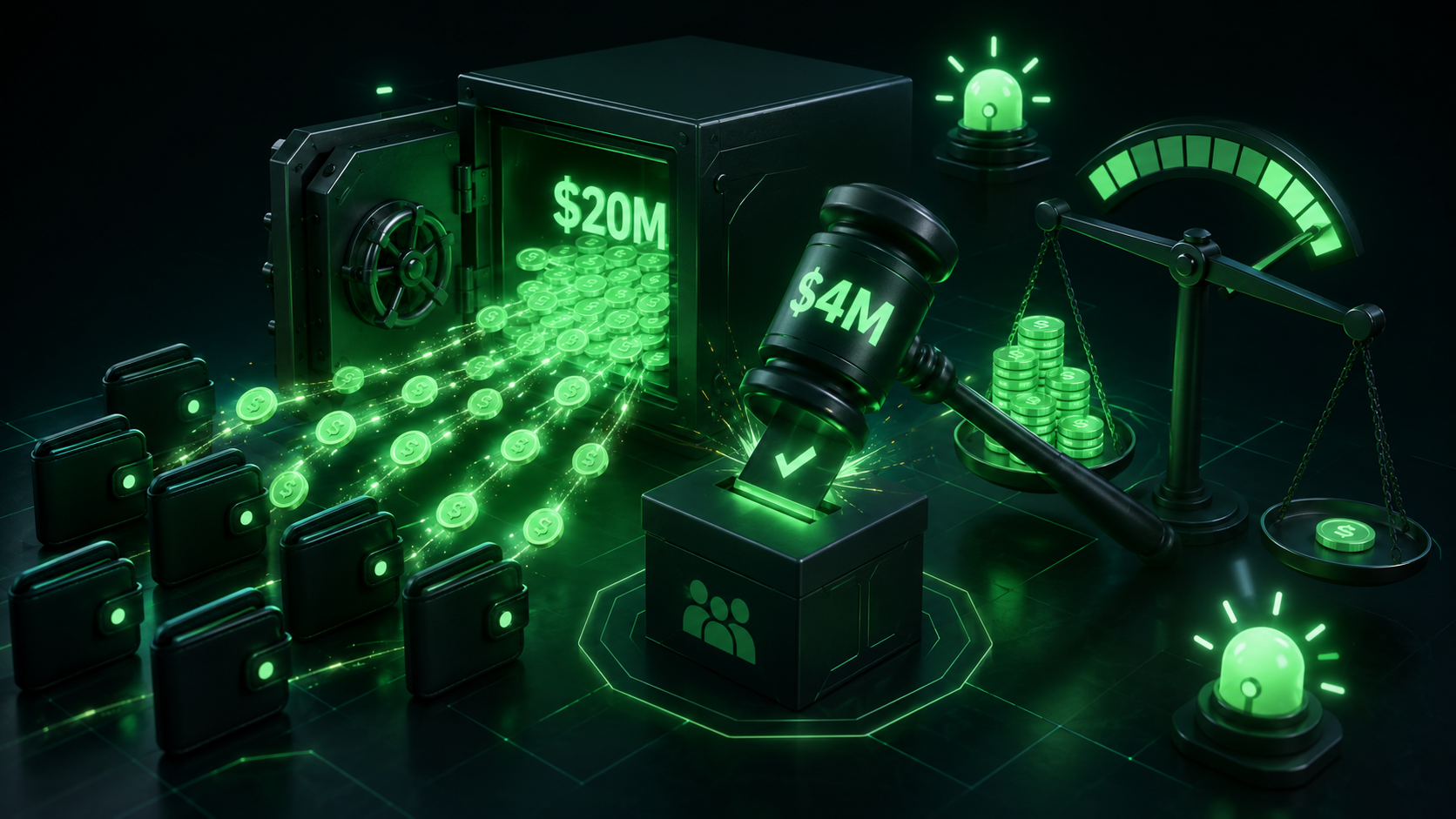
A governance proposal on BonkDAO passed with 99.9% approval. Seven wallets voted yes. More than 18,000 token holders did not vote at all. Buried under a pitch about rebuilding "from the ashes" sat the only line that actually mattered: a transfer of 4.43 trillion BONK, roughly $20 million, straight to the wallet of the person who wrote it. CoinDesk reported the attacker spent about $4.4 million to make it happen.
No contract was hacked here. Every line of code executed exactly as written, which is the part worth sitting with.
The Exploit Was the Rulebook
Call it a hack and you miss what actually happened. The smart contracts behind BonkDAO's treasury did their job perfectly. They counted the votes, checked that quorum was met, confirmed the proposal passed, and released the funds. The vulnerability lived in the governance design itself, which is a far harder thing to patch than a buggy function.
Here is the sequence, stripped of the noise:
- Buy the votes. The attacker spent roughly $4.4 million to acquire just over 1% of BONK's circulating supply. In a token-weighted system, that 1% is voting power you can rent on the open market.
- Exploit the apathy. BonkDAO's quorum threshold was low enough that a single motivated buyer could clear it. Turnout on the malicious vote was 2.9%. When almost nobody shows up, whoever does show up decides.
- Let the code pay out. The proposal was written to auto-execute on passing. Once it cleared, the treasury transfer fired automatically, with no human in the loop to notice that "monetize holdings" meant "send everything to me."
The attacker walked away with roughly a 4.5x return on the capital they put in. crypto.news laid out how the token-weighted math made it possible. And because the buyer still holds the BONK they purchased to vote, the true cost was only slippage and the fallout's price hit rather than the full $4.4 million.
Why "We Identified the Wallets" Rings Hollow
BonkDAO confirmed the raid on July 7 and announced it had identified the exchange wallets used to buy BONK before the vote, and that it was coordinating with exchanges, bridges, and the Solana Foundation. Solana is where the DAO lives, so that coordination is the only real lever left.
The uncomfortable truth is that an on-chain governance system that auto-executes cannot un-execute. The funds moved the instant the vote closed. Recovery now depends on the attacker being careless enough to route stolen tokens through a centralized venue that will freeze them, which is the same fragile hope every drained protocol clings to. BONK fell about 8.5% in the day after the raid, which tells you the market priced this as a real loss rather than a recoverable one.
There is a grim irony in a treasury designed to be owned by its community getting handed to a stranger by that same community's indifference. The 18,000 holders who did not vote were not asleep at the wheel. They were the wheel.
The LeveX Take
The lesson traders keep relearning is that where value sits determines how it can be taken. A DAO treasury governed by token-weighted votes is a pool of money with a public, programmable lock, and the combination that opens it is posted openly: buy X% of supply, clear a quorum most people ignore, submit the payout. This is a category of risk that has nothing to do with price and everything to do with structure.
That structural point is why verification matters more than reassurance. When funds sit with a custodian, the question that protects you is whether the backing is real and provable, which you can check for yourself. LeveX publishes 1:1 Proof of Reserves through a Merkle Tree, so a user can confirm the assets exist rather than trusting a statement that they do. The BonkDAO holders had full transparency into their treasury too, and it did them no good, because transparency without a workable way to act on it is just a good view of the robbery. Proof of Reserves matters precisely because it pairs the view with a claim you can independently check against your own balance.
The wider implication reaches every governance token in a portfolio. If a project's treasury is large relative to the cost of acquiring quorum-clearing voting power, that gap is a standing bounty. Traders holding governance tokens should be reading quorum rules and treasury-to-market-cap ratios the way they read tokenomics, because a poorly designed governance module is a slow-motion exit waiting for someone to pay the entry fee.
What This Repeats About DeFi's Blind Spot
DeFi has spent three years hardening smart contracts against reentrancy, oracle manipulation, and bridge exploits, and it has spent almost none of that energy on the boring machinery of governance. The BonkDAO raid is a reminder that the payout logic sitting behind a vote is as much attack surface as any lending pool. Every low-turnout DAO with an auto-executing treasury is running the same open experiment, and the entry fee just got advertised.
For traders sizing positions around BONK or any governance asset, the useful move is to treat governance parameters as a risk input rather than a footnote. BONK trades on LeveX for both spot and futures, and the Crypto in a Minute series breaks down how on-chain governance actually moves money, and where it can move the wrong way.