Challenges
Results
Allegro Energy is an Australian flow battery startup that has developed a water-based microemulsion electrolyte, combining water, oil, and surfactant, targeting one of the biggest barriers to grid-scale renewable firming: the cost and safety profile of long-duration energy storage. The chemistry is built from common, globally available raw materials rather than lithium or rare earths, giving it a non-flammable, fully recyclable profile suited to deployments where conventional battery chemistries carry fire risk or supply chain exposure, from utility grids and mining sites to data centers.
Headquartered in Thornton, New South Wales, Allegro manufactures its flow battery technology at a pilot facility in the Hunter Valley and has already moved its technology from lab to grid, deploying its first commercial pilot at Eraring Power Station, Australia’s largest coal-fired power station, to prove that water-based long-duration storage can perform at grid scale.
Getting from lab chemistry to a manufacturable, grid-ready product requires flow engineering at two very different scales: the centimeter-scale channels of the battery stack itself, and the tank volumes, ranging from 15,000 up to 100,000-plus liters depending on customer needs, that hold electrolyte between charge and discharge cycles. Finn Trass, a Process Flow Engineer at Allegro, works on the tank and system side, focused on how electrolyte mixes and moves through storage. Ryan Murphy, a Mechanical Engineer on Allegro’s Mechanical Design Team, works on the stack side, developing the internal fluid architecture of Allegro’s in-house battery stack.
From On-Premise Bottlenecks to Cloud-Native Confidence: Allegro Energy’s Adoption of SimScale
Before switching to SimScale, Allegro’s engineering team were running CFD simulations with an open-source solver using on-premises hardware. This approach severely limited the volume of simulations that the team could run, so they started looking for ways to scale that simulation activity. Cloud-native compute was the deciding factor in the move: it gave the team meshing and solve speed that matched the pace that iterative flow battery development demands. “The primary attraction of SimScale was the cloud-based computing, so you can get simulations done quicker,” Ryan recalls of the switch, made roughly two years ago. Today, Finn and Ryan have access to tens of thousands of CPUs between them. “The availability of compute is no longer a constraint,” Finn says. “If you’ve got to run a simulation, or 10s of simulations, go run them.”
Onboarding, five one-hour sessions with a dedicated technical support engineer, got Ryan up and running quickly. “Those sessions got me comfortable with the platform fast, and it’s stayed that way since,” Ryan says. Support has remained responsive since: despite a time difference with SimScale’s largely Germany-based team, questions sent one day are typically answered the next.
Multiphase CFD: Solving Mixing in Large-Scale Electrolyte Tanks
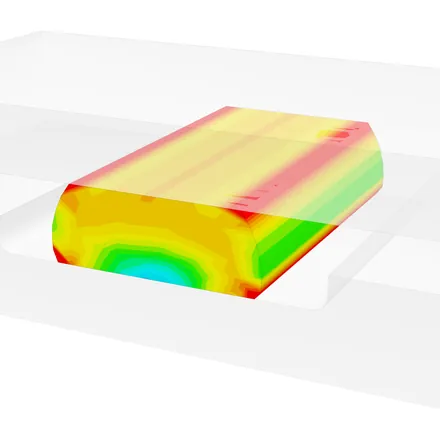
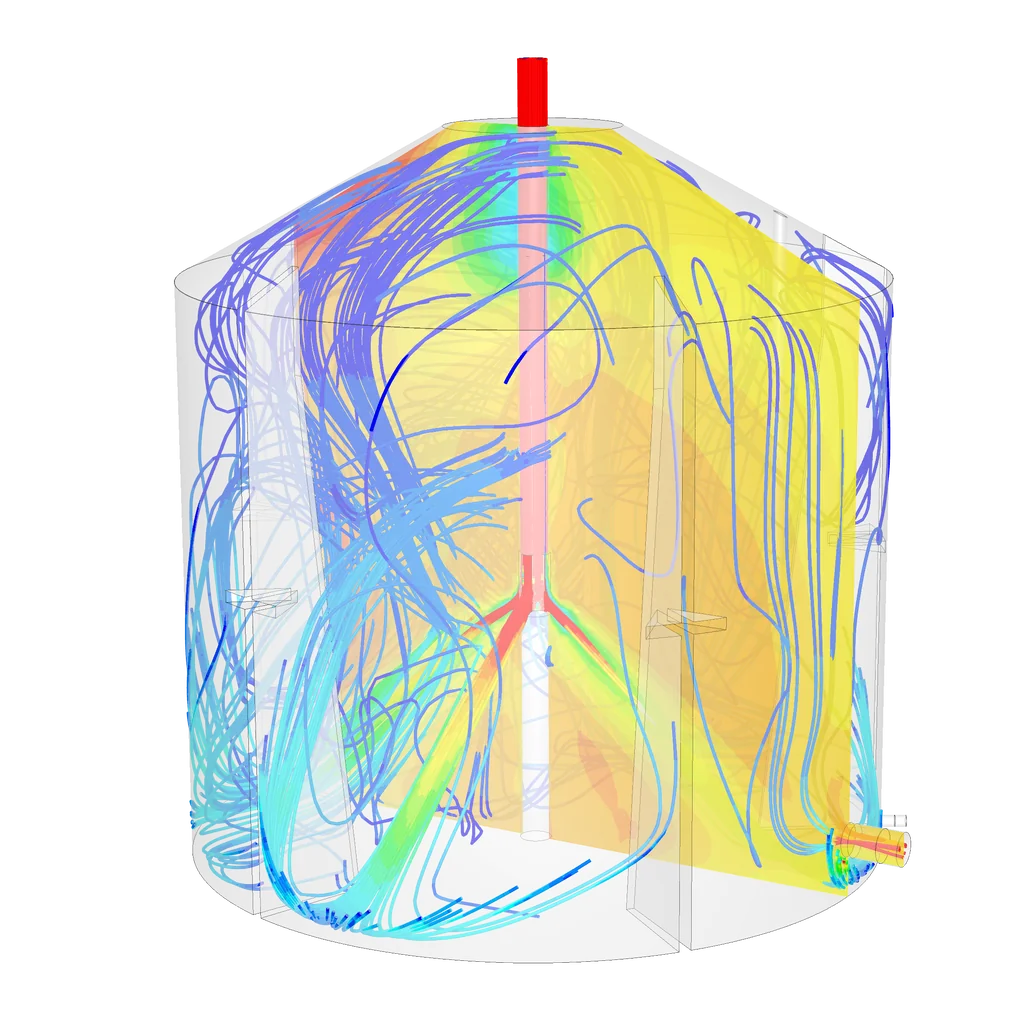
Flow batteries store their energy in liquid electrolyte held in external tanks, pumped through the stack to charge and discharge. Every customer wants a different capacity, which means a different tank: one current client is having a 20,000-liter tank built, the next wants 17,000 liters, and the one after that an entirely different shape. If that electrolyte isn’t well mixed inside the tank, pockets of it sit unreacted near the return jet rather than circulating, quietly eroding the battery’s usable capacity.

Finn Trass
Process Flow Engineer, Allegro Energy

“If the tank isn’t well mixed, you might turn an 8-hour battery into a 4-hour battery, because half of your electrolyte isn’t being used. Simulation is the only way to really assess how well the tank performs.”
Finn used SimScale’s multipurpose analysis type to run two-phase simulations of the electrolyte together with the tank’s nitrogen headspace, as well as the standard incompressible solver on the liquid-only simulations to calculate residence time throughout the tank volume. The workflow developed was to import models from Solidworks CAD and extract the fluid volume using SimScale’s built-in geometry handling capability.

A typical tank project can require 10 to 30 simulations to lock down a design before it goes to a fabricator – working through baffle designs, flow rate, and nozzle shape, depth and orientation. A second round of 5 to 10 simulations typically follows as the team works with the fabricator to arrive at a validated, manufacturable design. All of this design work needs to be completed to agreed milestones for each customer project.
“Being able to do so much simulation work before fabrication speeds up the whole process, since we have already answered most of the questions by then. I would say SimScale has accelerated the overall process by 2-3 times”
Parametric CFD: Engineering Flow Through Allegro’s In-House Stack
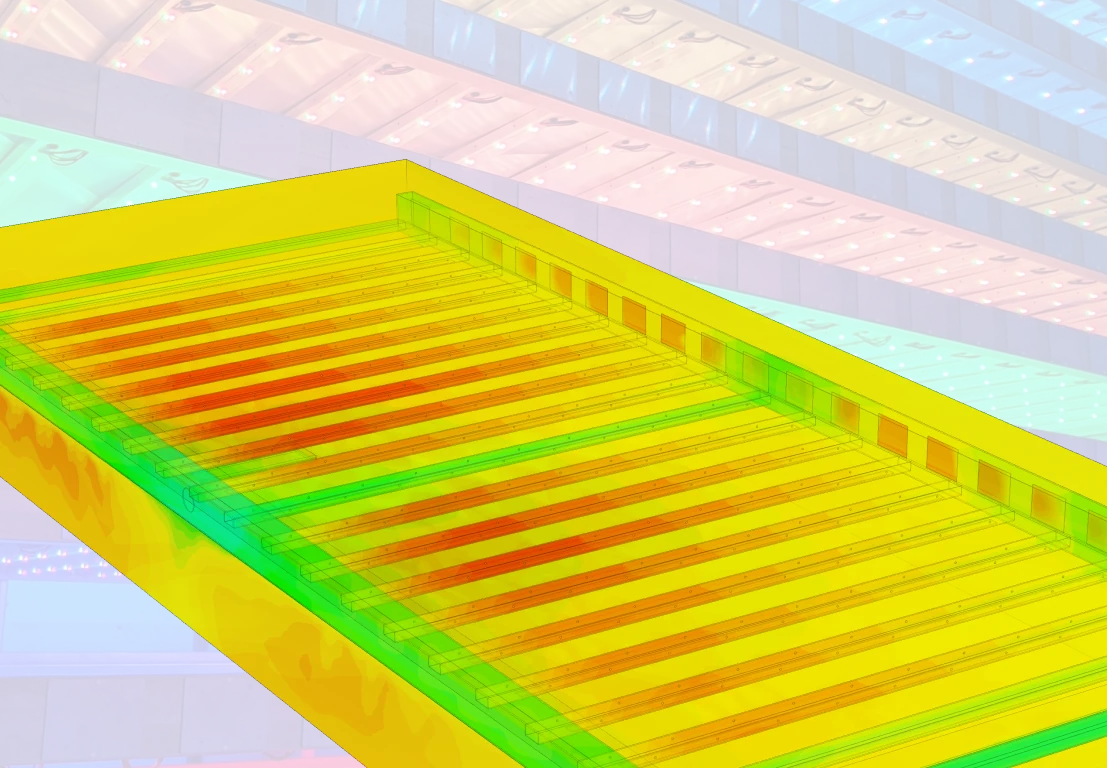
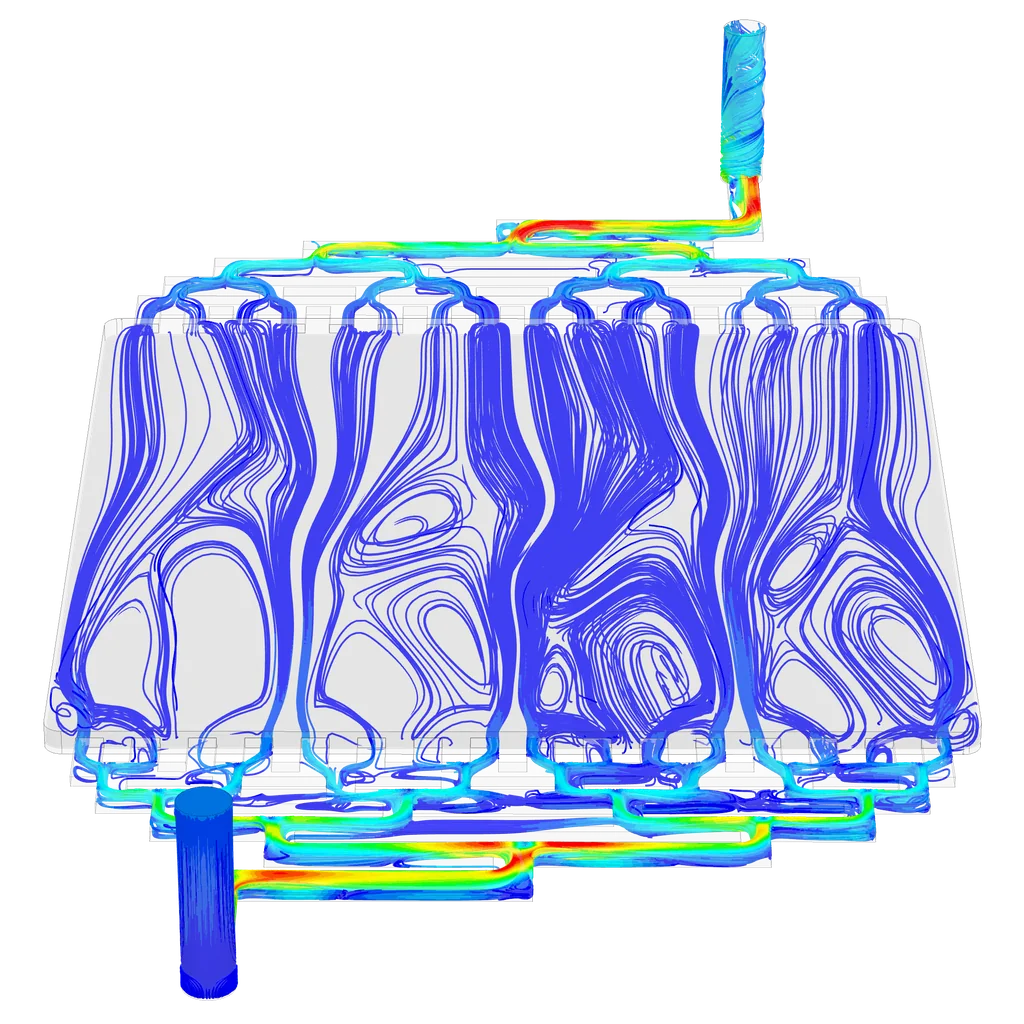
Inside the stack itself, the engineering problem inverts: instead of a large, slow-moving tank volume, Ryan works with tightly constrained internal geometry, where electrolyte has to pass through porous felt media and distribute evenly across the active area.
As the company works towards building its own stack design, Ryan’s simulation work focuses on optimizing for the two key competing objectives of minimizing pressure drop while maximising flow distribution across the membrane.

Ryan Murphy
Mechanical Engineer, Allegro Energy
“If you have really dense stacks with high pressure losses, you might need a considerably larger pump for the overall system. Simulation lets us understand the system and design correctly to it.”
Ryan uses parametric CAD to vary the fluid channel design, channel width and depth, corner radii, the number of bifurcations and inlets – a large design space which the team has explored over hundreds of simulations testing new stack architectures. To keep that iteration manageable, he builds up from the smallest unit: starting with a single-cell or half-cell frame, then scaling to a full stack depth with multiple cells once a design earns confidence at the smaller scale.

By running batches of 10 or more simulations concurrently, Ryan was able to quickly work through different flow rates against different felt compression ratios and architectures in parallel. “We were able to really take advantage of the cloud scale here and look at a lot of options and combinations. In the end we increased the flow uniformity by over 40%, which has a big impact on overall efficiency as well as resulting in a better engineered and higher quality product”, he adds.
Conclusion
Allegro Energy’s engineering challenge is really two problems that share the same fluid: getting electrolyte to mix properly across large tank volumes, and getting it to distribute evenly across the compact geometry of the stack. Both problems had previously been difficult to answer with confidence before committing to hardware or fabrication. SimScale’s cloud-native platform gave Finn and Ryan a shared way to answer both, without either needing dedicated simulation hardware.
Looking ahead, tank mixing studies could extend into more geometrically complex designs as Allegro’s storage capacity requirements grow, while stack-level parametric work could extend further into pressure loss optimization as new architectures come under consideration. At Allegro Energy, the question is no longer whether simulation belongs in the design process — it’s where to apply it next.
“SimScale is not like a legacy tool where you have to hike up the whole mountain. You can just get the ski lift up.”